The candidates, side by side
Before the claims, the records. Each candidate’s education, experience, and service is set out below. Justice Tufte’s entries come from his court biography and his own account. Mr. Johnson’s entries come from his campaign website, his law firm’s biography, and his answers to the League of Women Voters, in his own terms. Where his materials list nothing in a category, the table says so.
| Justice Jerod Tufte | Ari Johnson | |
|---|---|---|
| College | B.S., Computer Engineering, magna cum laude, Case Western Reserve University, 1997. | B.S., Computer Science, minor in mathematics, summa cum laude with departmental honors, University of North Dakota. |
| Law school | J.D., magna cum laude, Arizona State University, 2002. First in his class of 151. | J.D., College of William & Mary, 2007. |
| Bar admissions | Arizona, 2002 (now inactive). North Dakota, 2003. Registered patent attorney, United States Patent and Trademark Office, 2007. | Virginia, 2007 (now inactive). North Dakota, 2007. Minnesota, 2008. Montana, 2009. U.S. Supreme Court, 2016. |
| Before law school | Computer engineer, Motorola, in Chicago and Phoenix, 1997–1999. | Worked for a year in the Phoenix, Arizona, area in the computer science field. |
| Clerkship | Law clerk to Judge Roger L. Wollman, United States Court of Appeals for the Eighth Circuit, 2002–2003. | None listed. |
| Private practice | Patent litigation at a large Phoenix law firm, 2003–2005. Main-street solo practice in Steele, North Dakota, 2005–2011. Practice areas included business law, real estate, estate planning, and patent law. | Private practice since 2007: in Bismarck, 2007–2011, and since 2011 at Johnson & Sundeen in Watford City, where he is a partner. Lists oil and gas, personal injury, products liability, commercial litigation, appeals, probate, and estate planning among his practice areas. |
| Prosecution | Kidder County State’s Attorney: appointed 2005, elected 2006 and 2010. Served while the only lawyer in the county and tried criminal cases to juries. | McKenzie County Assistant State’s Attorney, 2011–2013 and 2025 to present. |
| Counsel to government and cooperatives | Legal counsel to Governor Jack Dalrymple, 2011–2014. General counsel, BEK Communications Cooperative, 2006–2011. | General counsel, McKenzie Electric Cooperative, 2022 to present. Zoning attorney for McKenzie County (2013 to present) and Dunn County (2012–2021). City attorney, Lincoln, North Dakota, 2010–2011. |
| Trial and appellate work as a lawyer | Criminal jury trials as Kidder County State’s Attorney, and a variety of bench trials in civil and criminal matters. | By his account, counsel of record in more than 600 civil cases, with at least one in each of the state’s eight judicial districts; 20 jury trials; and 25 cases argued to the North Dakota Supreme Court, plus appeals in the Eighth Circuit. Petitioned the U.S. Supreme Court for review in State v. Francis (2016); review denied. |
| Military service | Major, Judge Advocate, North Dakota Army National Guard, 2008–2016, including overseas service in Kosovo. | None listed. |
| Judicial service | District judge, Southeast Judicial District, 2014–2016, appointed by Governor Dalrymple; presided over a variety of jury trials. Justice of the North Dakota Supreme Court since 2017. Has taken part in more than 2,300 of the Court’s cases and written hundreds of its opinions. | None listed. |
| Court and law-reform leadership | Chairs the North Dakota Judicial Conference, its Executive Committee, and the Task Force on Lawyer Licensing and Alternative Legal Practice. Past chair of the Court Technology Committee. North Dakota Uniform Law Commissioner since 2015, now chair of the state commission. Chair, Uniform Law Commission AI Monitoring Committee, 2026. Rodel Judicial Fellowship, Class of 2025. | Past chair, Pattern Jury Instruction Commission; remains a member (commission roster). |
| Publications and service to the bar | Author, The North Dakota Constitution: An Original Approach Since 1889, 95 N.D. L. Rev. 417 (2020). Built two free public research sites: ndconst.org, which collects North Dakota constitutional sources from the 1889 convention debates to every later amendment, and ndlaw.org, which gives AI research tools citation-verified access to North Dakota opinions, statutes, court rules, and the constitution. Past member, Joint Committee on Attorney Standards. | North Dakota Association for Justice: president, 2018–2019; board of governors since 2010; 2024 Seventh Amendment Award. Past North Dakota delegate, American Association for Justice. |
| Elections | Elected Kidder County State’s Attorney in 2006 and 2010. Elected to the Supreme Court in 2016 with 60.7 percent of the vote. | First campaign for public office. |
| North Dakota roots | Born in Minot; attended West Fargo public schools. Has lived on a farm in rural Kidder County since 2005. | Born in Watford City; graduated from Watford City High School. Fourth-generation North Dakotan; has lived and practiced in Watford City since 2011. |
Sources. Justice Tufte: North Dakota Supreme Court biography; About and Record pages; 2016 results from the Secretary of State. Mr. Johnson: Johnson for Justice home, career, personal life, and FAQ pages; Johnson & Sundeen biography; League of Women Voters Vote411 candidate answers. Retrieved October 1, 2026. “None listed” means only that his published biographies list nothing in that category.
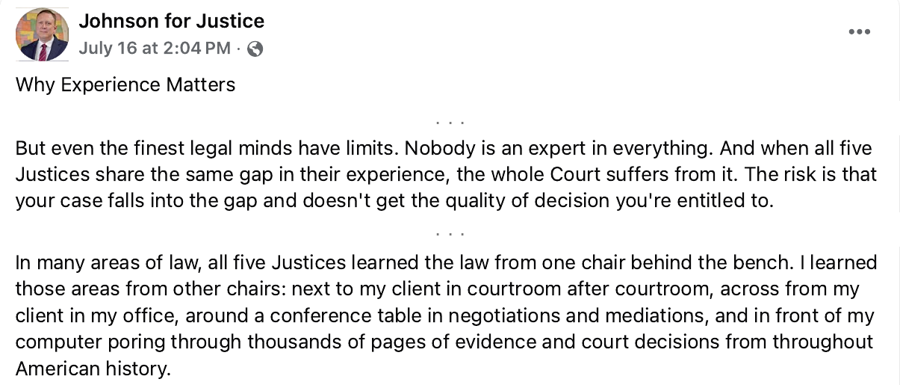
“One chair behind the bench”
What he said
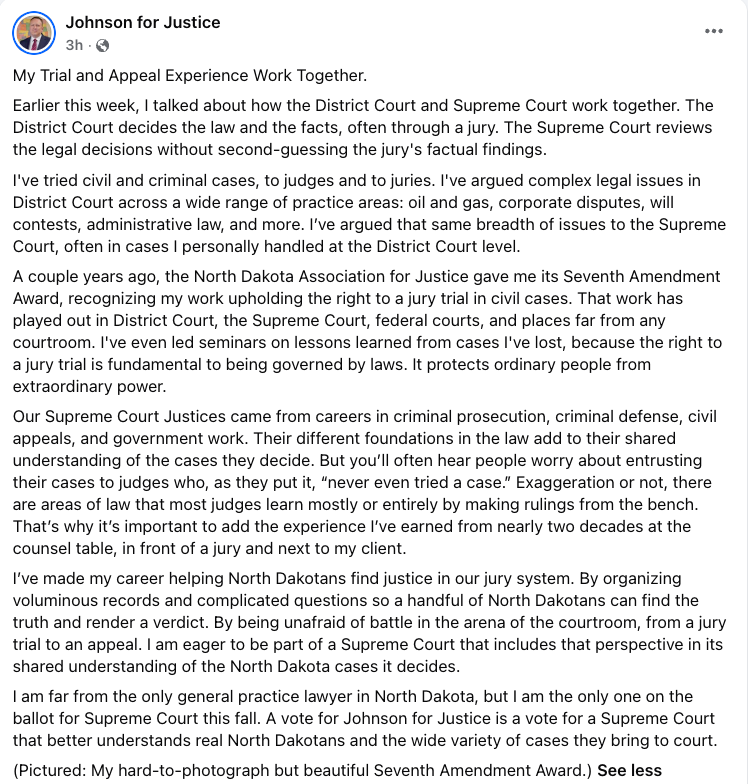
“Our Supreme Court Justices came from careers in criminal prosecution, criminal defense, civil appeals, and government work. … you’ll often hear people worry about entrusting their cases to judges who, as they put it, ‘never even tried a case.’ Exaggeration or not, there are areas of law that most judges learn mostly or entirely by making rulings from the bench.”
Johnson for Justice on Facebook, July 30, 2026
The rest of the story
Every Justice on this Court practiced law before taking the bench. All five spent time in private practice. Four of the five were also district judges, presiding over trials before joining the Supreme Court.
“Never even tried a case” does not remotely describe anyone on this Court, and if Mr. Johnson will “often hear” this, he should correct it rather than repeat these false statements about the qualifications of the current Justices.
“Gaps in the Court’s understanding”
What he said
“… my campaign is built on using my two decades of practical experience to fill gaps in the Court’s understanding of the law.”
Johnson for Justice on Facebook, “Judicial Opinions Beyond the Majority,” September 2026
“I don’t think any of our current Justices litigated a Pugh clause for a mineral owner or a prescriptive easement for a landowner.”
Candidate Q&A, The Summons (Western Dakota Association of Legal Assistants), August 2026
The rest of the story
Mr. Johnson has argued his own cases to this Court, and he has written about them on his campaign page. Here is what the opinions show about who decided them.
- His “clear win.” On August 27 he wrote about Kluver v. SGJ Holdings, a Dunn County jury trial he called “a clear win.” The Supreme Court affirmed that verdict unanimously. The opinion of the Court was written by Justice Jerod Tufte and joined by Justices Jensen, McEvers, and Bahr, along with then-Justice Crothers. Kluver v. SGJ Holdings, LLC, 2023 ND 65.
- His Pugh clause case. Mr. Johnson argued and won Tank v. Citation Oil & Gas Corp., a Pugh clause appeal. Justice McEvers sat on that panel. 2014 ND 123.
The Justices he says have gaps are Justices who decided his cases, including the one he calls a clear win.
“The people who run them don’t feel the itch”
What he said
“A Justice who has used court technology extensively as a customer can best understand and champion real improvements. My undergraduate degree was in Computer Science …”
Johnson for Justice on Facebook, July 23, 2026
“Our state courts have, for reasons never shared with me, chosen not to update the software.”
Johnson for Justice on Facebook, “The Color Ink Defense, Part 2,” September 17, 2026
The rest of the story
Justice Tufte earned a computer engineering degree, magna cum laude, and worked as an engineer at Motorola before law school. He then practiced as a prosecutor and a solo lawyer before joining the bench, and he is a past chair of the Court Technology Committee. Court biography.
As for reasons never shared: in the same September 17 post, Mr. Johnson quotes the written reply he received from the State Court Administrator. It said the issues he raised were not “sufficient to justify the cost and labor involved in switching vendors or to undertake the process of designing and building a custom system.” He also writes that he was put on a call with the vendor. He disagrees with the answer.
“In the arena”
What he said
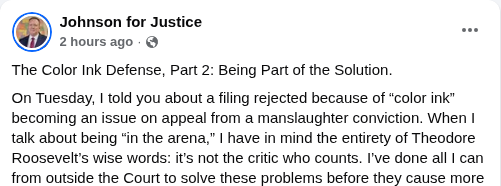
“When I talk about being ‘in the arena,’ I have in mind the entirety of Theodore Roosevelt’s wise words: it’s not the critic who counts. I’ve done all I can from outside the Court to solve these problems before they cause more problems.”
Johnson for Justice on Facebook, “The Color Ink Defense, Part 2,” September 17, 2026 (#InTheArena)
The rest of the story
Mr. Johnson asks readers to take Roosevelt’s words in their entirety. Here they are:
“It is not the critic who counts; not the man who points out how the strong man stumbles, or where the doer of deeds could have done them better. The credit belongs to the man who is actually in the arena, whose face is marred by dust and sweat and blood; who strives valiantly; who errs, and comes short again and again, because there is no effort without error and shortcoming; but who does actually strive to do the deeds; who knows the great enthusiasms, the great devotions; who spends himself in a worthy cause; who at the best knows in the end the triumph of high achievement, and who at the worst, if he fails, at least fails while daring greatly, so that his place shall never be with those cold and timid souls who know neither victory nor defeat.”
Theodore Roosevelt, “Citizenship in a Republic,” address at the Sorbonne, Paris, April 23, 1910, in African and European Addresses (G.P. Putnam’s Sons 1910) (text)
Roosevelt gave the credit to the one who carries the responsibility, not to the one who points out where the work could have been done better. On court technology, Mr. Johnson has told us which of the two he is. By his own description, he has worked “from outside the Court.” From there he has pointed out real flaws in the e-filing system, and some of his complaints are fair. That is a useful thing for a lawyer to do. It is also the part Roosevelt assigned to the critic.
The arena on this question is where the trade-offs are made and answered for. The reply Mr. Johnson received from the State Court Administrator, which he quotes himself, weighed his list of defects against “the cost and labor involved in switching vendors or to undertake the process of designing and building a custom system.” A court system works within a budget the Legislature sets. Every dollar spent on one improvement is a dollar that cannot be spent on another, and the people responsible for the choice answer for it either way.
A lawyer filing a brief sees the bug in front of him. The Court has to see every clerk of court, every county, every self-represented litigant, and every competing need at once. That is a different arena from a courtroom, and Roosevelt’s credit goes to the one who “errs, and comes short again and again, because there is no effort without error and shortcoming.”
“I would put my own tech skills to work fixing them”
What he said
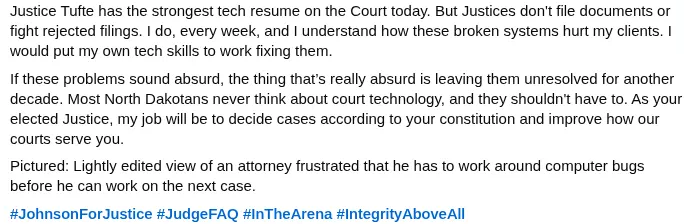
“Justice Tufte has the strongest tech resume on the Court today. But Justices don’t file documents or fight rejected filings. I do, every week, and I understand how these broken systems hurt my clients. I would put my own tech skills to work fixing them.”
Johnson for Justice on Facebook, “Why should voters care about court technology?,” October 7, 2026
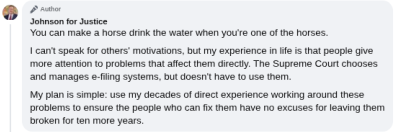
“My plan is simple: use my decades of direct experience working around these problems to ensure the people who can fix them have no excuses for leaving them broken for ten more years.”
Johnson for Justice, reply on Facebook, October 5, 2026
The rest of the story
Mr. Johnson asks voters to trust his technical skills with the courts’ software. In this race he has been responsible for one public-facing system: his own campaign website, the one he tells voters to visit for details.
At 4:32 p.m. on October 9, the security certificate for johnsonforjustice.org expired. Anyone who loaded the site while the certificate was expired was met by a full-page browser warning instead of his campaign.

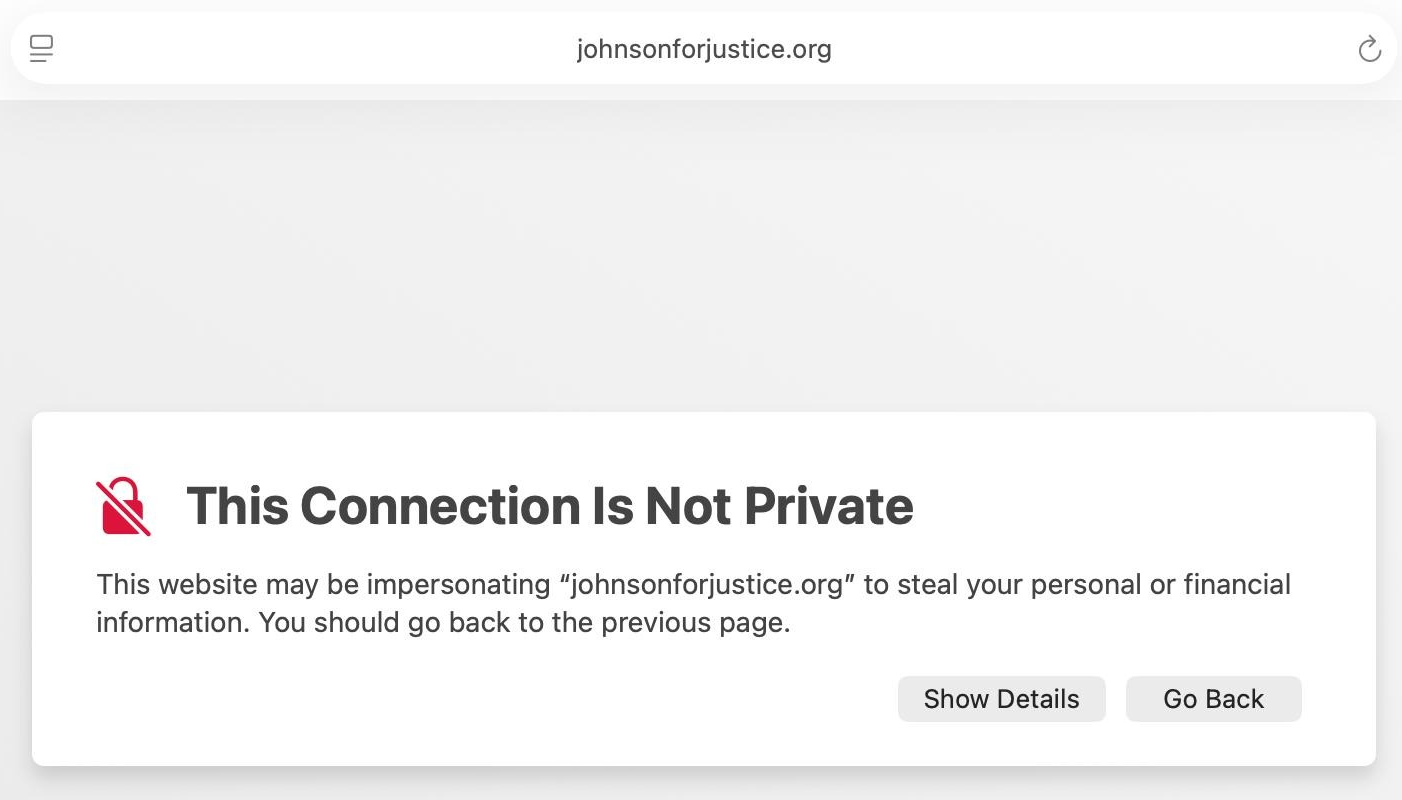
It is not the first time. The site’s certificate also expired on June 30, and that time the warning stayed up for eleven days, until a new certificate was installed on July 11. That certificate was good for ninety days. It ran out on schedule, with no renewal. Every certificate issued for a website is recorded in public logs, so anyone can check these dates: certificate history for johnsonforjustice.org.
Keeping a certificate current is about as routine as website upkeep gets. The kind his site uses is free and built to renew automatically. Nothing suggests anyone’s information was actually at risk; the warning appears because the certificate lapsed. That is the point. This is the easy part.
A statewide court system is not the easy part. It has to work for every clerk, every county, and every litigant, every day, on a budget the Legislature sets. Mr. Johnson says the people responsible for court technology should have “no excuses.” Twice now, the one system his own campaign is responsible for has turned voters away for lack of a routine renewal. Voters can weigh that against his promise to fix the courts’ software.
“Judging people from afar”
What he said
“Two decades representing North Dakotans in and out of court. You can’t earn that perspective by judging people from afar.”
Johnson for Justice ad, Meta Ad Library
“A vote for Johnson for Justice is a vote for a Supreme Court that better understands real North Dakotans …”
Johnson for Justice on Facebook, July 30, 2026
The rest of the story
Justice Tufte and his wife, Mylynn, settled on a farm in rural Kidder County in 2005. He served as the county’s State’s Attorney while he was its only lawyer, then as a district judge in the Southeast Judicial District. He served eight years as a Judge Advocate in the North Dakota Army National Guard, including overseas service in Kosovo.
That is not “from afar.”
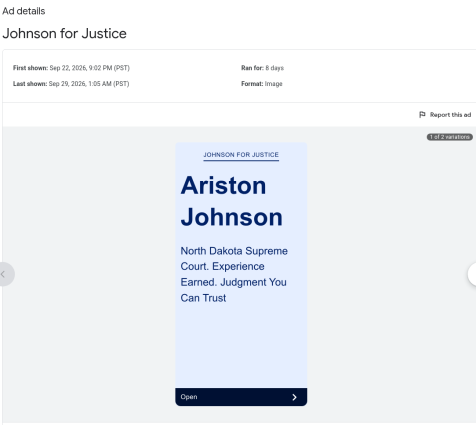
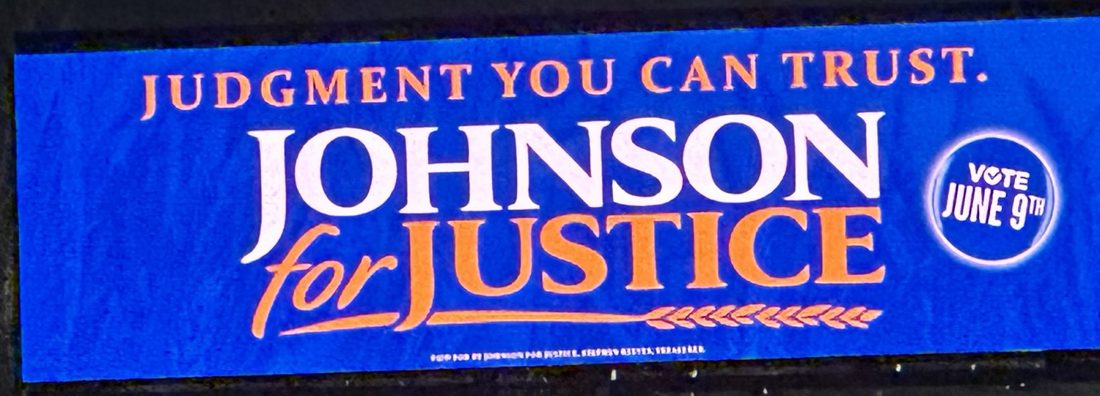
“Judgment you can trust”
What he said
The rest of the story
Any candidate can promise good judgment. For someone new to the bench, voters have to take that promise on faith. An incumbent’s judgment can be checked against the written record. Justice Tufte has taken part in more than 2,300 Supreme Court cases and written hundreds of the Court’s opinions. Every one is public.
Read them at ndcourts.gov, and see his record and judicial philosophy.
“No political debts”
What he said
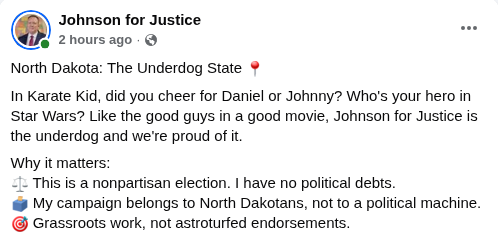
“No Political Endorsements or Favors”
Featured card on the Johnson for Justice Facebook page
The rest of the story
Justice Tufte did not reach the Supreme Court by appointment. He ran for an open seat in 2016 and won it from the voters with 60.7 percent of the vote. Secretary of State results.
As for political endorsements: the North Dakota Monitor reported on September 21 that Republican state Sen. Dale Patten of Watford City endorsed Mr. Johnson at a meet-and-greet. Sen. Patten told the paper Mr. Johnson did not know it was coming. North Dakota Monitor, Sept. 21, 2026.
“I will apply the law as written”
What he said
“As a judge, I will apply the law as written. … I will apply the law based on a deep understanding of the facts.”
Johnson for Justice on Facebook, September 2026
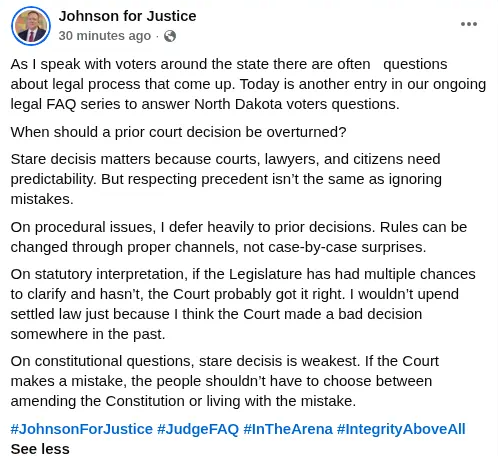
“And if the people don’t fix it because the legislature doesn’t fix it, I don’t think that the court should change its interpretation of the same law …”
KFGO News and Views, May 11, 2026
The rest of the story
Those two promises pull in different directions. If an earlier court misread what the Legislature wrote, Mr. Johnson’s rule keeps the misreading in place for as long as the Legislature is silent. Applying the law as written means reading the words the Legislature actually enacted. When the Court has gotten those words wrong, the text is still the law.
As for “a deep understanding of the facts,” Mr. Johnson explained the problem himself on July 28: the Supreme Court “doesn’t hold trials at all. It reviews the legal decisions made in District Court and, generally, defers to the factual decisions made there, by judge or jury.” The facts belong to the jury and the trial judge. A Justice’s job is to get the law right.
And now you know the rest of the story.
About this page
Quotations of Mr. Johnson are taken from his public Facebook page, his paid advertising as shown in the Meta Ad Library and Google Ads Transparency Center, a published candidate questionnaire, and a radio interview. Screenshots were captured from public pages on the dates shown and are cropped to the post; “…” marks omitted text. If you believe anything on this page is inaccurate, tell us and we will correct it.